

Technical insight
Starter Battery vs Start-Stop Battery: What Is the Difference?
Compare starter and start-stop batteries by cranking duty, cycling, charging, electrical loads and fitment before selecting a replacement range or sample.
A starter battery is designed primarily to deliver a short, high-current pulse that cranks an engine. A start-stop battery must do that repeatedly and also support vehicle electrical loads while the engine is off. It may operate at partial state of charge and accept energy during controlled or regenerative charging.
Both can be “starting batteries,” but they are not automatically interchangeable. The vehicle duty, approved technology, electrical ratings, case, terminals, charging system and registration procedure decide the correct product.
For distributors and workshops, this distinction determines which models belong in a conventional starting range and which require a start-stop validation process.
Key takeaways
- Conventional starter duty centres on reliable engine cranking.
- Start-stop duty adds frequent restarts, engine-off loads and repeated charge/discharge events.
- CCA alone does not describe cycling or charge acceptance.
- AGM and EFB are established start-stop lead-acid designs; sodium-ion is a separate alternative requiring system validation.
- A battery that fits the tray may still be the wrong technology for the vehicle.
Starter battery vs start-stop battery at a glance
| Decision factor | Conventional starter battery | Start-stop battery |
|---|---|---|
| Primary duty | Short engine-cranking event | Repeated cranking plus engine-off electrical support |
| Typical operating pattern | Fewer starts with alternator recharge during driving | Frequent starts and partial-state-of-charge operation |
| Common lead-acid technology | Conventional flooded SLI | EFB or AGM, depending on vehicle |
| Charge behaviour | Conventional alternator profile | May include smart alternator and regenerative charging |
| Vehicle monitoring | Varies | Battery sensor/BMS is common |
| Replacement process | Specification and fitment check | Specification, fitment, charging and possible coding/registration |
This is a duty comparison, not a statement that every conventional vehicle uses flooded lead-acid or every start-stop vehicle uses AGM.
What a conventional starter battery is designed to do
The starter motor requires high current for a short period. The battery must maintain enough voltage to crank the engine and keep control systems operating during the start.
Key selection fields include:
- nominal voltage;
- CCA under a stated test standard;
- capacity and reserve requirements;
- case dimensions;
- terminal layout and polarity;
- hold-down design;
- temperature range;
- charging compatibility.
After the engine starts, the alternator recharges the battery and supplies vehicle loads. A simple starting application may not expose the battery to repeated deep or partial cycling, although short journeys, parasitic loads and poor charging can still create difficult service.
NaVolt’s B and D Series are positioned as 12 V sodium-ion starter batteries for candidate passenger, commercial and equipment projects. Model-specific specifications control selection; the series name does not prove vehicle fitment.
What changes in start-stop duty
Restart frequency
The system can shut down and restart the engine at multiple stops within one journey. Each restart removes charge and creates a high-current event.
Electrical support while stopped
When the engine is off, the alternator is not supplying its normal output. The battery may carry ventilation, lighting, infotainment, controllers and other systems. The vehicle must preserve enough energy for the next restart.
Partial state of charge
Smart charging may reduce alternator load during acceleration and recover energy during deceleration. The battery can spend time below full charge, then accept a relatively strong recharge pulse when conditions permit.
Battery monitoring
Many start-stop vehicles estimate battery state using current, voltage and temperature data. The system may suspend start-stop operation if restart confidence is low. A replacement may need registration or coding so the controller recognizes the new battery.
These extra duties are why a conventional flooded starter battery is generally not an acceptable downgrade where the vehicle specifies EFB or AGM.
Why CCA is only one part of the comparison
CCA measures cold-cranking performance under a defined procedure. It is essential for starting, but it does not directly state:
- how the battery tolerates repeated partial cycles;
- how quickly it accepts charge;
- how long it can support engine-off loads;
- how it performs at other temperatures;
- whether it is compatible with the charging system;
- whether it physically fits the vehicle.
Always record the CCA standard. Battery Council International notes that its CCA definition and European CCA methods are not identical, even when numerical values may be similar.
Conditioning, temperature, discharge time and voltage limits must therefore be recorded whenever buyers compare two CCA figures.
Technology choices for each duty
Conventional flooded lead-acid
This remains a common solution for conventional SLI starting. It uses free-flowing electrolyte and is optimized around the manufacturer’s intended starting and reserve requirements.
EFB
Enhanced Flooded Battery is still a flooded lead-acid design, but it includes features intended to improve cycling and service life for start-stop use. It is commonly specified for less demanding start-stop systems.
AGM
Absorbent Glass Mat is a valve-regulated lead-acid design. It retains electrolyte in glass-fibre separators and is commonly specified for advanced start-stop systems, regenerative charging and high electrical demand.
Sodium-ion
Sodium-ion uses a different cell chemistry and pack design. It can be engineered for high-rate cranking and repeated-start applications, but it must be assessed against the complete vehicle system.
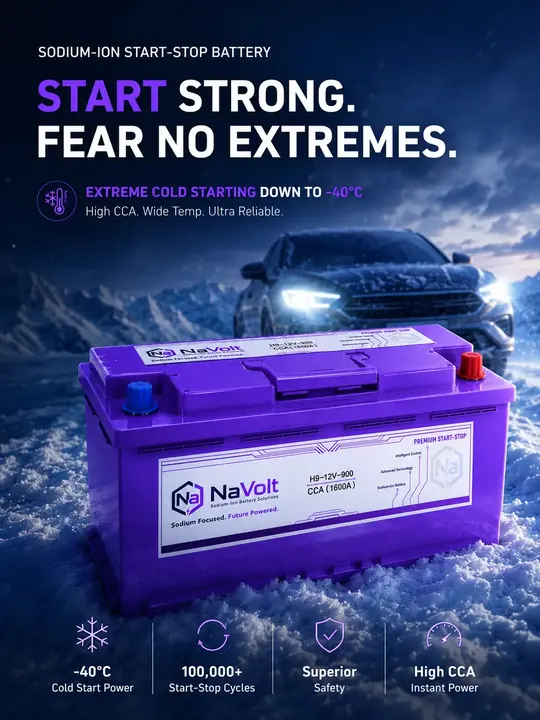
NaVolt separates its sodium-ion starter and start-stop product categories. This keeps conventional starting and repeated start-stop selection paths distinct. The broader start-stop battery guide explains how AGM, EFB and sodium-ion enter that second selection path.
Can a starter battery replace a start-stop battery?
Not simply because it has the same voltage, Ah, CCA or case size. If the vehicle specifies AGM or EFB, use the approved technology and specification unless an engineering programme has validated another solution.
An unsuitable battery can result in:
- rapid state-of-charge decline;
- reduced start-stop availability;
- shortened service life;
- charging or diagnostic faults;
- repeated warranty returns;
- an unreliable restart reserve.
These are possible outcomes, not a claim that every incorrect battery fails immediately. Vehicle design and operating conditions affect the result.
For the direct problem-solving answer, see Can You Use a Normal Battery in a Start-Stop Car?.
Selection workflow for buyers
Step 1: Define duty
Record start frequency, trip length, engine-off electrical loads, climate, parking duration and operating schedule. A taxi, delivery van, private passenger car and standby machine can have very different duty even at the same nominal voltage.
Step 2: Confirm the original specification
Capture the label, vehicle application, battery technology, CCA standard, Ah rating and case reference. Check whether the vehicle has start-stop, regenerative charging, an intelligent battery sensor or an auxiliary battery.
Step 3: Verify fitment
Dimensions, terminal interface, polarity, hold-down and cable clearance form one installation system. Use the starter battery fitment guide before ordering a sample.
Step 4: Review charging and registration
Measure the actual charging profile and confirm any BMS reset, registration or coding requirement. An external charger also needs the correct mode and limits.
Step 5: Approve the product scope
Validate a current production sample on the exact vehicle configuration. Approve by make, model, year, engine and market rather than by group-size label alone.
Distributor range planning
A B2B product range should label duty clearly. Suggested internal fields include:
| Field | Why it belongs in the master record |
|---|---|
| Product category | Separates conventional starter and start-stop use |
| Model code | Maintains commercial identity |
| Current rated CCA | Prevents model-suffix assumptions |
| Capacity | Supports engine-off and reserve review |
| Dimensions/order | Prevents case-data errors |
| Terminal interface | Identifies adapter or cable design needs |
| Charge requirement | Supports vehicle/charger review |
| Approved applications | Limits unsupported fitment claims |
| Evidence revision | Connects claims to current documents |
FAQ
Is a start-stop battery still a starter battery?
Yes, it starts the engine, but its duty also includes repeated restarts, engine-off electrical loads and frequent recharge events.
Is a higher-CCA starter battery suitable for start-stop use?
Not necessarily. Higher CCA does not prove cycling, charge acceptance, monitoring-system or fitment compatibility.
Can I fit an AGM battery to a vehicle without start-stop?
Only when the vehicle charging system, case, terminals and manufacturer guidance support it. AGM is not a universal upgrade for every conventional vehicle.
Do all start-stop vehicles use AGM batteries?
No. Many use EFB, some use AGM, and alternative systems may be engineered for the duty. Follow the exact vehicle specification.
Can sodium-ion be used for both duties?
NaVolt has separate starter and start-stop product categories. A model is approved only after its electrical and physical specification matches the defined application.
Conclusion
The difference between a starter battery and a start-stop battery is the operating duty. Both must crank the engine, but start-stop operation adds frequent cycles, engine-off loads and controlled charging. Select by the vehicle system and application evidence, not by voltage or CCA alone.
Use the duty, original specification and fitment record to check the correct NaVolt battery category before selecting a B, D or H Series sample.
Sources
- Battery Council International, Acronyms and Glossary of Common Battery Terms.
- GS Yuasa, E-learning documentation on start-stop vehicle battery duty.
- VARTA Automotive, Lead-acid, AGM and EFB battery technologies.
- NaVolt current approved product specifications.